Project
Learning Personalization Engine
A private-code personalization system that turns learning-platform events into mastery traces, recommendation inventories, and teacher-facing review surfaces.
Python Bayesian Knowledge Tracing pytest Playwright probes JSON fixtures recommendation rules
Read article Private repo
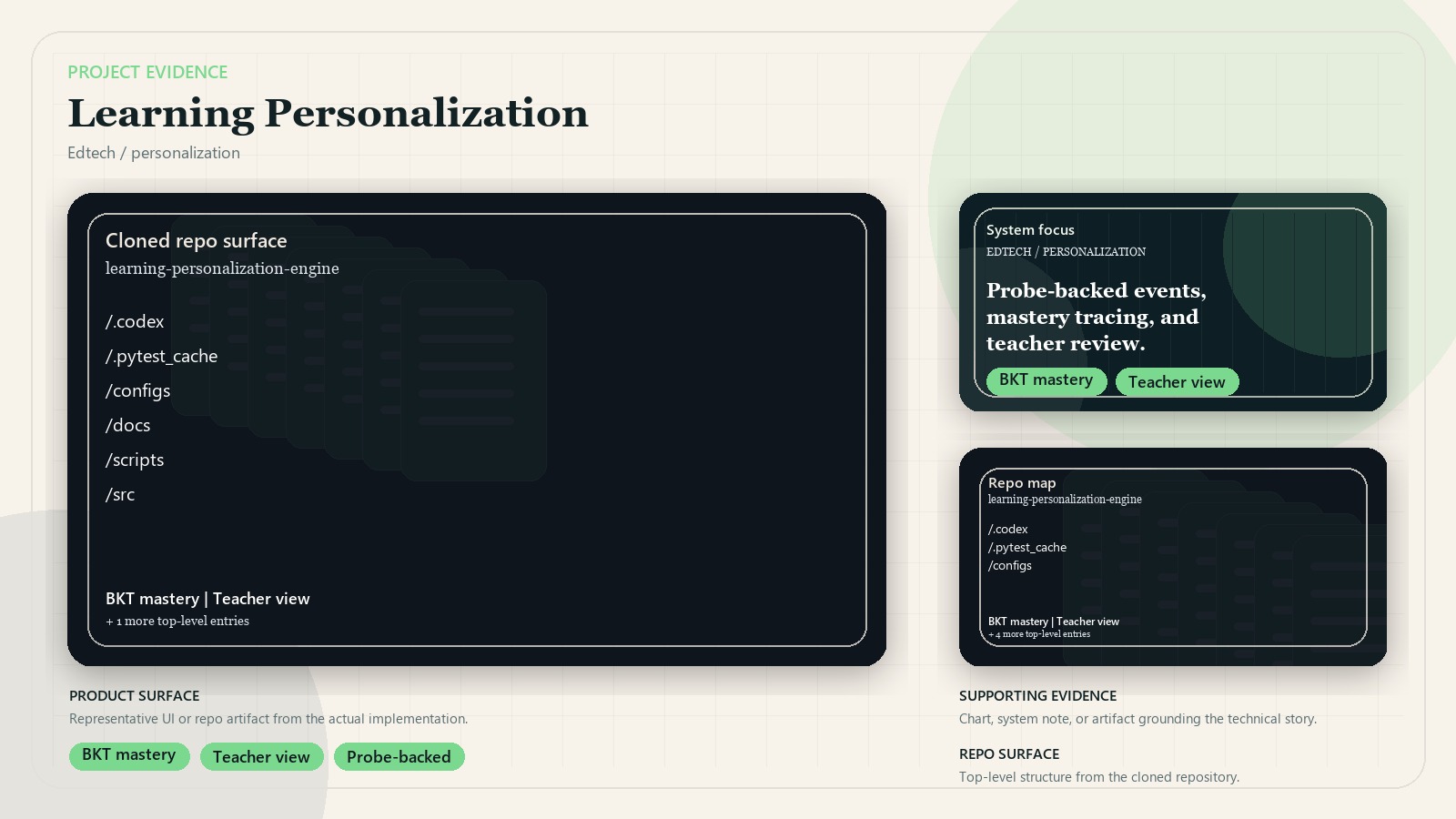
Source code is private. The public case study and article focus on event contracts, personalization logic, review surfaces, and verification.
Business context
Learning platforms often collect useful activity signals without turning them into a clear personalization workflow. The hard part is not only predicting learner state. The system also needs a defensible event contract, assumptions that can be reviewed, recommendations that teachers can inspect, and testable boundaries between platform observation and instructional action.
Outcome
- Built a private-code engine for normalizing learning events, estimating mastery, and generating recommendation inventories.
- Added probe-backed ingestion paths for platform observations while keeping public documentation anonymized.
- Implemented local validation scripts and 32 passing tests across event parsing, knowledge tracing, recommendation rules, stores, metadata, and end-to-end pilot outputs.
- Produced teacher-view summaries that keep personalization advice reviewable instead of hiding it behind an opaque score.
Key decisions
- Treated platform observations as evidence that must be normalized before personalization logic can use it.
- Kept mastery estimation, recommendation rules, and teacher-facing summaries as separate layers.
- Used fixtures and deterministic tests so the engine can be verified without exposing private platform data.
- Avoided raw platform screenshots in the public portfolio because the useful story is the architecture, not the private UI.
System design
Browser probes and local fixtures feed a normalized event layer. Profile rollups and knowledge-tracing utilities convert those events into mastery estimates and learner state. Recommendation inventory logic then maps that state into reviewable next actions, while pilot scripts generate teacher-facing summaries and audit artifacts. The repository keeps credentials, deployment-specific details, and platform observations outside the public case study.
Stack
- Python package with event contracts, BKT-style tracing, recommendation rules, and local stores
- pytest coverage for core model and workflow behavior
- Playwright-based platform probes for authenticated inspection when credentials are available
- JSON fixtures and scriptable validation outputs for repeatable pilot checks